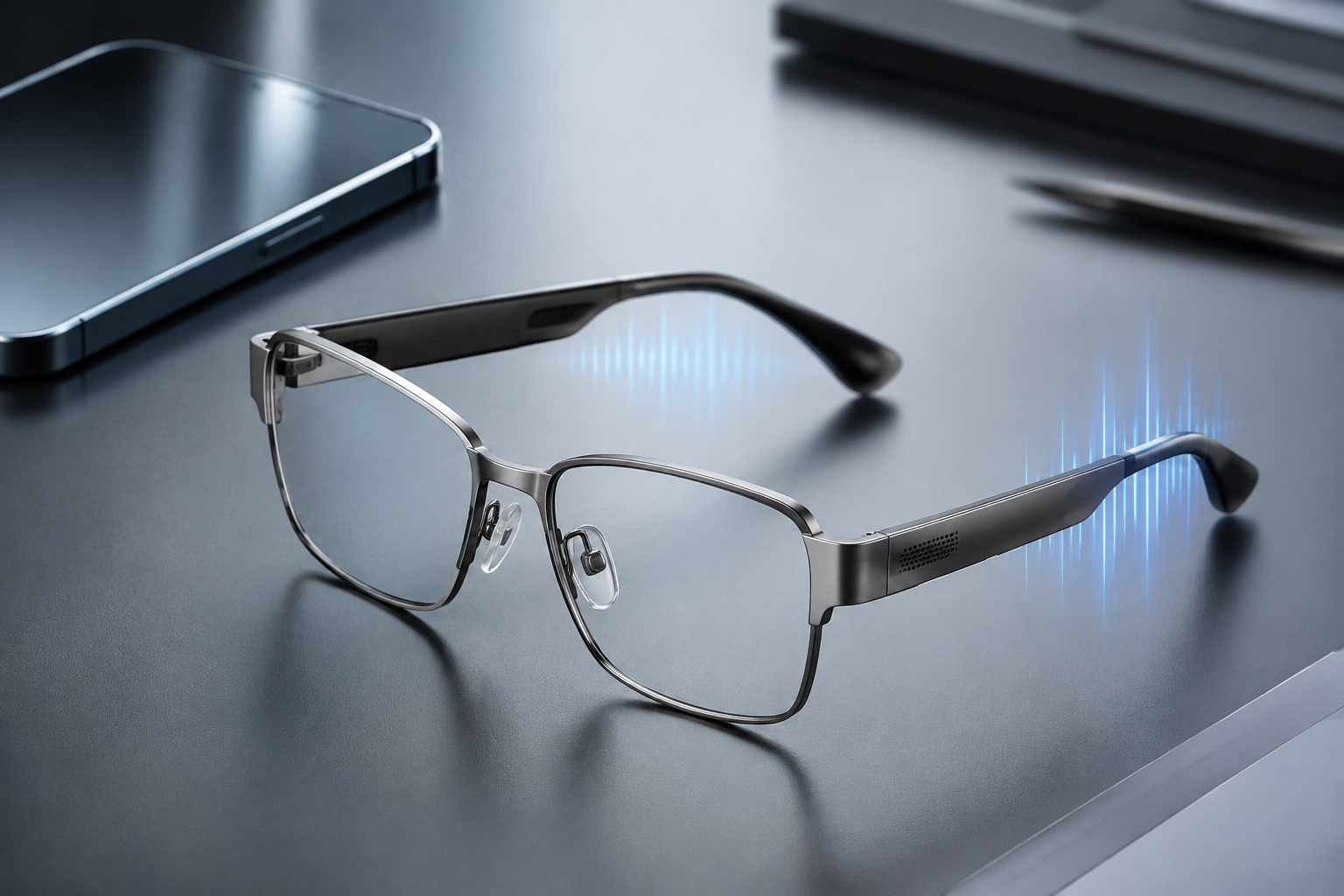
Xiaomi’s Mijia Smart Audio Glasses place open-ear speakers, microphones and touch controls inside a conventional-looking frame. The lightest titanium version weighs 27.6 grams without lenses, while Xiaomi rates the device for up to 13 hours of continuous playback and nine hours of calls under laboratory conditions.
That makes the glasses an alternative to earbuds for calls, podcasts and background music. It does not make them a direct replacement for camera-equipped smart glasses: the Mijia model has no camera and no visual display.
Key specifications
- Audio: open-ear speakers integrated into the temples
- Microphones: four, with claimed wind-noise reduction up to 4.5 m/s
- Playback: up to 13 hours at 50% volume in Xiaomi’s tests
- Calls: up to nine hours
- Standby: up to 12 days
- Charging: approximately one hour; ten minutes can provide up to four hours of playback
- Wireless: Bluetooth 5.4 with dual-device connection and Google Fast Pair
- Protection: IP54 dust and splash resistance
- Compatibility: Android 10 or later and iOS 14 or later
Open-ear audio, not bone conduction
Xiaomi uses small speakers to project sound toward the ears while leaving the ear canal uncovered. The company explicitly says the product does not use bone conduction. The benefit is environmental awareness: users can hear traffic, announcements and nearby conversations without removing an earbud.
The trade-off is leakage and limited isolation. People nearby may hear audio at higher volumes, while noisy streets can overpower quieter content. Xiaomi includes a privacy mode that uses a reverse sound field and acoustic membrane to reduce leakage, but it cannot create the isolation of sealed in-ear headphones.
Three frame options with different weights
The range includes Pilot-Style, Browline and Titanium frames. Xiaomi lists the Titanium version at 27.6 grams without lenses and 34.4 grams with its supplied lenses. The other two frames weigh just over 32 grams without lenses.
The temples narrow to 5 mm at their slimmest point. A piano-wire hinge is designed to distribute pressure and withstand repeated flexing, while the second-generation quick-release system allows the front frame to be changed.
Calls, recording and controls
Four microphones handle calls and audio recording. Xiaomi claims its algorithms can reduce wind noise at speeds up to 4.5 m/s. That figure comes from controlled testing; call quality will still depend on traffic, surrounding voices and the wearer’s fit.
Touch bars on both temples can control playback, calls, notifications and a phone’s voice assistant. The Xiaomi Glasses app manages gestures, battery status, recordings, connected devices and notification reading. Recording must be used in accordance with local privacy and consent laws.
Battery life and charging
The headline 13-hour playback figure was measured at 50% volume with AAC audio. Real use will vary with volume, call time, dual-device connections and temperature. Xiaomi also lists nine hours of continuous calling, 1.5 days of typical use and 12 days on standby.
A full charge takes about one hour. The claimed fast-charge result—four hours of listening from ten minutes—can be useful during a workday, although it remains a laboratory figure rather than a guarantee for every charging source.
How they compare with Meta smart glasses
Comparisons with Meta’s Ray-Ban line need care. Both products can play open-ear audio and handle calls, but their scope is different. Xiaomi’s Mijia Smart Audio Glasses omit the camera, video capture and visual AI features associated with camera-equipped rivals.
That omission may be an advantage for buyers who want discreet audio and fewer privacy concerns. It is a limitation for anyone expecting first-person photography, live streaming or visual assistance. The better description is “audio glasses,” not a full augmented-reality device.
Price and availability
A 20 Minutes buying guide listed the glasses at €208.88 through Amazon France on September 3, 2026. Marketplace prices change frequently and may involve third-party sellers, so buyers should verify the seller, warranty region, return terms and included frame before ordering.
Xiaomi’s official regional pages provide the more reliable reference for specifications and compatibility. Availability and frame choices can differ by country.
Who should consider them?
The Mijia Smart Audio Glasses suit users who spend much of the day on calls or spoken-word audio and do not want their ears blocked. The light titanium frame, dual-device support and long rated playback make sense for office and commuting use.
They are less suitable for private listening in quiet shared spaces, strong bass, air travel or anyone who wants a camera. Buyers who already wear prescription lenses should also confirm glazing options and the final fitted weight with an optician.
FAQ
Do Xiaomi Mijia Smart Audio Glasses have a camera?
No. This model is designed for open-ear audio, calls, recording and voice-assistant controls. It does not include a camera or visual display.
Are they bone-conduction glasses?
No. Xiaomi says they use an open sound-field solution with speakers that direct audio toward the ears.
How long does the battery last?
Xiaomi claims up to 13 hours of continuous playback, nine hours of calls and 12 days of standby under its stated test conditions.
Can they connect to two devices?
Yes. The Mijia model supports dual-device connection over Bluetooth 5.4.
Are they waterproof?
They are rated IP54, meaning resistance to limited dust and splashes. They are not designed for swimming or immersion.