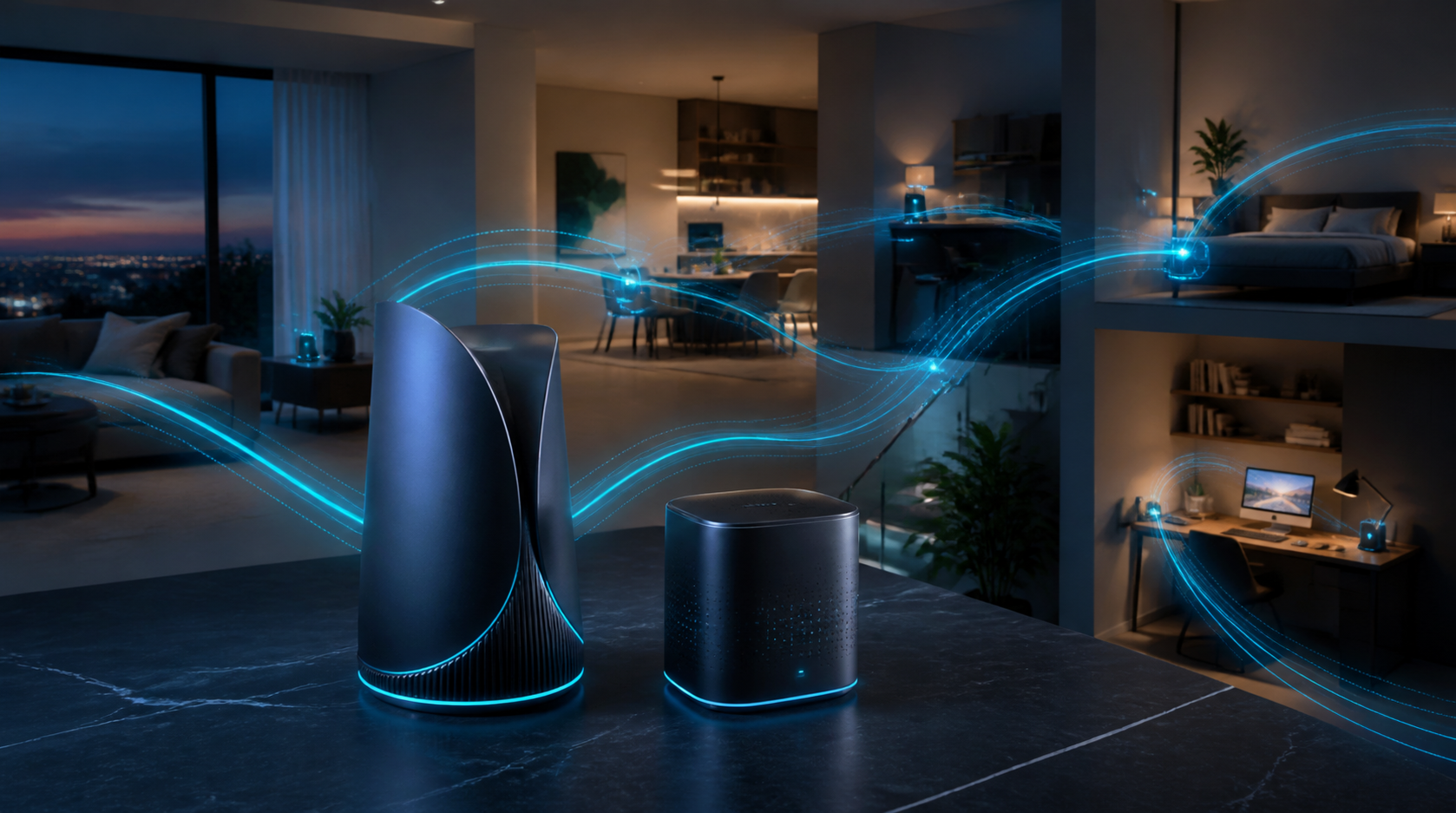
TP-Link has taken an early step into the next generation of wireless networking with two flagship Wi-Fi 8 products: the Archer 8 Ultra router and the Deco 8 Ultra mesh system. Introduced at IFA 2026, both devices are based on the developing IEEE 802.11bn standard and are designed to improve not only headline speed, but also network stability in busy, interference-heavy homes.
Two Wi-Fi 8 flagships for different homes
The Archer 8 Ultra, also identified as the BN19000 or Archer BN800, is a tri-band consumer router. TP-Link rates it for aggregate wireless throughput of up to 19 Gbps and wired connectivity up to 10 Gbps. Its hardware includes 18 internal antennas, an unusually large array intended to support broad and consistent coverage without the external antennas found on many performance routers.
The Deco 8 Ultra, also known as the BN22000 or Deco BN85, applies the same generation of technology to a whole-home mesh system. TP-Link advertises aggregate wireless speeds of up to 22 Gbps alongside 10 Gbps wired connectivity. According to the company, a three-unit system can cover as much as 9,800 square feet, or roughly 910 square metres, and serve more than 200 connected devices. Model names and rated speeds may vary by region.
The 22 Gbps figure needs context
The advertised figure is aggregate capacity across multiple frequency bands, not a promise that one laptop or phone will download at 22 Gbps. Real performance will depend on the client device, channel conditions, distance, interference, the internet connection and the wired network behind the router. A home also needs compatible multi-gigabit equipment to take meaningful advantage of 10 Gbps Ethernet.
That distinction matters because Wi-Fi 8 is being positioned less as a dramatic increase in peak speed and more as a way to make fast wireless connections behave consistently. For many households, reliability at the edge of coverage and responsiveness under congestion may be more useful than a larger theoretical number.
Wi-Fi 8 focuses on reliability
TP-Link groups its reliability features under the name StabilityEngine. The announced technologies include Enhanced Long Range and Distributed Resource Units, which aim to improve uplink performance for distant or low-power devices. Non-Primary Channel Access is intended to preserve responsiveness when networks become crowded, while Unequal Modulation and new modulation and coding schemes are designed to maintain throughput under difficult interference conditions.
These improvements could be relevant in homes containing many cameras, sensors, televisions, computers and mobile devices. They may also help mesh systems maintain steadier connections between rooms, although independent testing will be needed before the benefits can be judged.
An early product generation
TP-Link plans to disclose full product and regional availability details during an online event on September 30, 2026. Reports indicate that Archer 8 Ultra pre-orders are expected to begin in selected regions around that date, while broader timing for the Deco system may extend into 2027. Pricing has not yet been confirmed and availability will differ by market.
Potential buyers should also remember that Wi-Fi 8 client devices are still emerging. A new router can continue to serve older Wi-Fi equipment, but its most advanced features require compatible clients. Early adopters should therefore evaluate the complete network rather than judging the purchase on the router's maximum rating alone.
Should you wait for Wi-Fi 8?
Users who already have a stable Wi-Fi 6E or Wi-Fi 7 network are unlikely to need an immediate upgrade solely for higher advertised throughput. The first Wi-Fi 8 systems make more sense for enthusiasts, large multi-gigabit homes, demanding local-network workloads and environments where many devices compete for airtime.
The more important story is TP-Link's shift toward predictable performance. If the final products deliver stronger edge coverage, better uplink behavior and fewer interruptions under load, Wi-Fi 8 may feel faster even when a speed test never approaches the maximum printed on the box.