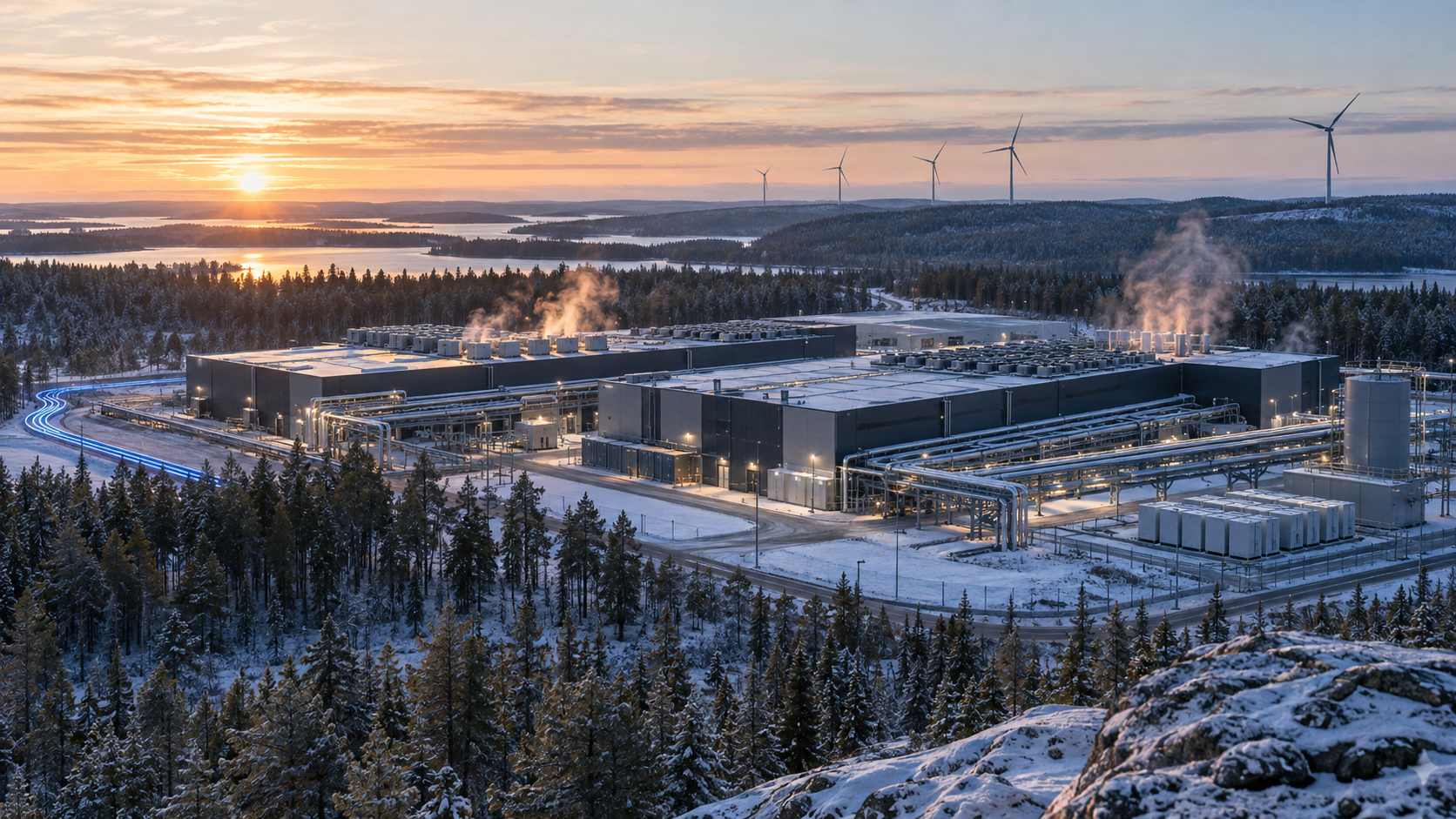
Google plans to invest at least €13 billion in data centres and supporting digital infrastructure in Finland during 2027 and 2028. The programme covers Hamina, where Google already operates a large campus, and new or expanded infrastructure partnerships in Kajaani, Muhos and Vaala.
Google describes the commitment as its largest single investment in Europe. The company is pairing the computing buildout with long-term electricity contracts, wind generation, battery storage, heat recovery and local training programmes as it expands capacity for AI and cloud services.
The investment at a glance
- Value: at least €13 billion
- Period: 2027–2028
- Locations: Hamina, Kajaani, Muhos and Vaala
- Purpose: data-centre, AI and supporting digital infrastructure
- Energy measures: nuclear power agreement, wind PPAs, a 94 MW battery project and grid coordination
- Community funding: €31 million over four years, including €10 million for research and innovation
The headline figure is a planned investment rather than money already spent. Construction schedules, permits, equipment delivery and energy connections will determine how quickly individual parts enter service.
Four Finnish locations
Hamina
Google has operated in Hamina for more than 15 years. It bought a former paper mill in 2009 and converted the site into a data centre. The campus uses seawater-based cooling and is connected to an off-site heat-recovery project designed to provide up to 80% of the annual energy required by Hamina’s district-heating network.
The company says its Hamina activity worked with more than 600 Finnish suppliers between 2023 and 2025, including construction, networking and operational partners.
Kajaani, Muhos and Vaala
The new programme expands Google’s northern Finnish footprint. These locations provide access to strong grid connection points near sources of low-carbon electricity. Google is working with Fingrid and Business Finland to identify connections that can use existing northern grid capacity and reduce the need for additional transmission investment.
A contracted 94 MW battery system near the Kajaani site is expected to become operational in late 2027. It is intended to supply grid flexibility during periods of low wind and high demand.
Why Finland attracts data-centre investment
Finland combines a cool climate, a relatively low-carbon electricity system, reliable institutions and strong fibre connectivity. Cooler external temperatures can reduce the energy required for data-centre cooling, although the overall environmental result still depends on server utilization, building design and the source of electricity.
The country also has established engineering, telecommunications and industrial suppliers. Google says the expanded capacity will support its services, including Gemini, Search, Maps and YouTube, while giving Finnish organizations lower-latency access to cloud and AI infrastructure.
A 22-year agreement linked to nuclear power
One of the most significant parts of the energy package is a 22-year power-purchase agreement with Fortum. Google says the contract provides revenue certainty for a programme to extend the operating life of the Loviisa nuclear power plant near Hamina.
According to the announcement, Loviisa currently supplies about 10% of Finland’s electricity and employs approximately 580 people. Google and Fortum also signed a memorandum of understanding to explore additional flexible and carbon-free generation, including possible business models for new reactors at the site.
A power-purchase agreement does not mean Google owns or exclusively operates the plant. It is a long-term commercial commitment to buy electricity under agreed terms, supporting the economics of continued generation.
Wind capacity and battery storage
Google also announced additional onshore wind contracts with Valorem and Suomen Hyötytuuli. The company says its Finnish agreements now support 629 MW of new-to-the-grid onshore wind capacity.
Wind output varies with weather, which is why storage and grid coordination matter. The planned Kajaani battery is designed to respond more quickly than a conventional generator and help balance short-term changes in supply and demand. It will not provide all the power required by the data centres on its own.
Economic impact figures require context
Google projects that the construction phase will contribute an annual average of €3.6 billion to Finnish GDP and support more than 37,000 jobs nationwide in 2027–2028. About 16,000 of those roles are estimated to be in construction, generating €911 million in average annual labour income.
Once the facilities are operating, the company projects support for 7,000 jobs per year across direct operations, suppliers and local businesses. It also estimates average wages associated with the activity at 24% above Finland’s median.
These are forward-looking economic-impact estimates published with the investment announcement. They include indirect and induced employment, not only permanent engineers working inside data centres. Actual results will depend on construction progress, Finnish sourcing and the final operating scale.
Skills, research and local funding
Google is allocating €31 million over four years to community programmes in the four municipalities, with €10 million earmarked for research and innovation. Other initiatives cover biodiversity restoration, public energy-efficiency projects and local infrastructure.
Through partner organizations, the company says more than 4,400 workers will receive AI-skills training. A separate programme with EKAMI is expected to prepare up to 100 students over one year for data-centre careers.
The infrastructure questions Finland must manage
Large AI facilities consume significant electricity and require grid capacity, cooling systems, backup power and network connectivity. Finnish Prime Minister Petteri Orpo welcomed the investment while acknowledging public and industrial concern about whether electricity will remain sufficient and affordable.
The energy agreements are designed to address part of that challenge, but their performance should be judged through measurable results: new generation connected, recovered heat delivered, battery availability, grid congestion and local electricity costs.
Water and land use also need site-level scrutiny. Hamina’s seawater cooling and heat-recovery arrangement cannot automatically be assumed to apply identically to every northern facility.
What the announcement means for European IT
The investment adds substantial AI-compute capacity inside the European Union at a time when businesses and governments are seeking lower-latency services, regional resilience and clearer control over where workloads run.
Physical location alone does not resolve every question about data sovereignty. Customers must still review service regions, replication, encryption, access controls, contractual jurisdiction and compliance configurations. However, more Finnish capacity gives European organizations additional infrastructure options closer to their users.
FAQ
How much is Google investing in Finland?
Google announced plans to invest at least €13 billion in digital and AI infrastructure during 2027 and 2028.
Where will the investment be made?
The programme includes Hamina, Kajaani, Muhos and Vaala.
Is the €13 billion already invested?
No. It is a forward-looking two-year investment plan whose delivery will depend on construction, permits, equipment and energy connections.
How many jobs will it create?
Google projects support for more than 37,000 jobs nationwide during construction and 7,000 annually once operational. These estimates include direct, supply-chain and induced employment.
Will the data centres use nuclear power?
Google signed a 22-year power-purchase agreement with Fortum connected to extending the life of the Loviisa nuclear plant. The wider energy package also includes wind contracts and battery storage.
What is the planned battery capacity?
A 94 MW battery system near Kajaani is expected to connect to the Finnish grid in late 2027.
Sources
- Google Cloud — €13 billion Finland AI infrastructure announcement
- Government of Finland — Prime Minister Petteri Orpo’s speech at Google’s announcement
- Finnish Government — National roadmap for data-centre and digital-economy development
- Le Figaro — Google announces €13 billion investment in Finland